course info

snow college - art 2950

Tuesday, February 16, 2021

Sensory Deprivation - Andrea Martinez

 For my experiment, I decided to do it with one of my friends and put into practice her sense of smell and concentration. The experiment consists of putting types of sauces, dressings, syrups, and soap on lids so that my friend will smell it and try to guess what it is. I will cover their eyes and put headphones on with some music. Putting coffee on her side will help neutralize odors. 

The point of this experiment is to see how my friend uses her sense of smell by identifying the samples. The music will be a distraction for her. She would need to really concentrate and I will be able to see focuses on the scent of the sauces, condiments, and dressings despite the noise coming through her headphones. Covering her eyes will help her to focus more.


During the process, my friend was able to identify three samples out of eight. She felt weird because she was not able to see what I was putting in front of her. The condiments were more difficult than the sauces and dressings. In the beginning, she thought that music was not going to be a distraction for her, but for being a music major she was focusing more on the music instead of the samples. 


Sensory Deprivation - Calli Sumsion


Sensory Deprivation, Calli Sumsion

            For my experiment, I decided to focus on losing the sense of sight and some way of touch. When it comes to creating an art piece I am used to drawing with my own hand and visually seeing what I want to create. So, what I did was blindfold myself as I had a piece of paper in front of me, then I would have a person move my hand for me to have me draw whatever they wanted. They could talk to me but could not tell me what they were having me draw. And there was no time limit.

I was inspired by John Cage to make the audience the performers. I was just the instrument.

            I already know with different people it would change the experience. I first had my 11-year-old sister, Quincy, take a turn. I did not realize how tight it would feel but because I didn’t know what I was drawing I didn’t worry about how I should move my hand or if I was doing it right. Then I had my 16-year-old siter, Dannon, go right after. It was honestly quite entertaining for me with both sisters. And I’m still confused, but the whole time Dannon kept telling me to relax but it was impossible since she was squeezing it so tight. As they were both using me as a puppet, they were mostly struggling with themselves than me.

            After each person’s drawings, I asked what the easiest aspect of the experiment. Quincy said that because she knew it was an experiment and it was not her hand, she had fun just trying. Dannon thought the whole time it was hard. The hardest thing for both of them was the fact that they couldn’t feel exactly what they were doing.

            I think I always knew but I never realized how much touch can change everything. Just by bending the wrist or curling a finger, it can make quite the difference. Or Quincy felt that it was hard without feeling her own nerves moving with the pencil.

            Quincy had so much fun that she drew a purple frog on a 3 eyed mushroom. And I loved it so much that I recreated it in my own style. 


Sunday, February 7, 2021

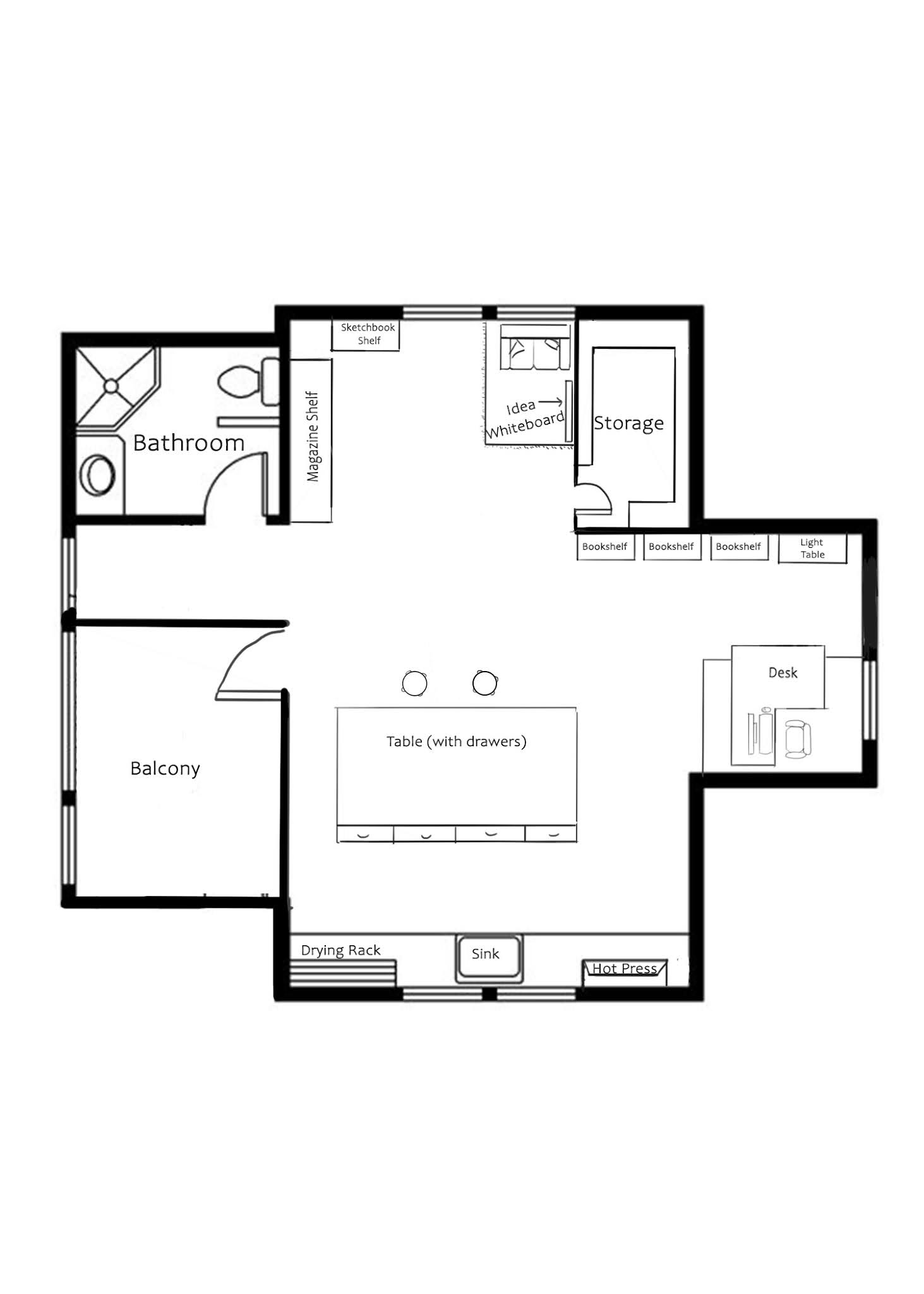
Creative Environment - Calli Sumsion


  • big glass windows to let in natural light
  • Easy floors to clean (either concrete or wood)
  • big table in the middle for art projects
  • organization throughout on caddies and on the opposite wall
  • another work area on the side for anything digital
  • good wifi for inspiration and connecting with others
  • plants everywhere to make it more homey
  • mini kitchen area for snacks (as well as the sink to clean up)
  • comfy chair to easily work in
  • tv on the opposite wall (movies and music help motivate and inspire me)
  • library upstairs (a place to relax as well as receive more inspiration
  • beautiful garden view 
  • in a more suburbs area so I have space and nature but still really close to shopping areas for resources
  • sofa and coffee table to relax as well as have guests over
  • my future dog hanging around since I love dogs
  • a gallery wall of other artist's work as well as family photos
  • bright colors and open space
  • (and this would be connected to a part of my house or in the backyard)

Creative Environment (Safe and Risk ) - Andrea Martinez


Safe 

  • Working with materials I have experience with
  • Talking with people about my art
  • Learn about artists and non-artists
  • Have a big space 
  • Natural light
  • Be comfortable with my clothes 
  • Be comfortable with my workspace 
  • Peaceful space with low music 
Comfort Space

  • Comfy chair
  • White Walls
  • White Light
  • A lot of materials 
  • Plants
  • Wi-Fi
  • Instrumental music 
  • Big windows 
  • Big workspace
  • Kitchen
  • Bathroom
Risk

  • Working with unfamiliar materials
  • Having a lot of stress
  • Yellow light
  • Not having enough materials to work with
  • Not have good communication with my group
  • Not having the words to express my art
 

Saturday, February 6, 2021

My Creative Space - Allison Ipson


My Creative Space

  • Built in the loft of my house
  • Stairs from the back door lead directly to loft so visiting people don’t have to walk through entire house 
  • Bathroom by stairs making it a self sufficient area
  • Immediately upon walking up stairs, opens into large open area which includes a family rest area, library, and open railing looking out onto the living room 
  • Family area includes window seat, air hockey, ping pong, some plants and has a wood style linoleum floor 
  • Library has bookshelves, bean bags, chairs, a window seat, and a table and carpet 
  • Next to the bathroom is a project/craft room for various mediums, including a sewing section and a supply counter/shelves
  • Craft room also has a couple tables in the middle, a desk by the window, some plants, a fish tank, and houses the idea corner and darkroom door 
  • Idea corner has a white board wall and a bulletin board, allowing for any inspirations, including images, artists, or concepts to be hung and also notes to be written on the wall 
  • Darkroom door is a light proof turn door that leads into darkroom
  • Darkroom has an enlarger, as well as a large chemical sink
  • Photo processing room is connected to darkroom by curving dark hallway that blocks out light 
  • Photo processing room has stored darkroom chemicals, a counter, sink, and photo drying rack 
  • Portrait studio has connecting doors to photo processing room and library and includes a seamless wall, a hanging backdrop area, studio lights, and a printer for photos and matting station


Encourages Risks: 

  • Space for multiple mediums, encouraging me to get outside my comfort zone
  • Accessible to my whole family, making it so I have to discuss my work more than I currently do
  • Door to studio from outside that makes it more accessible to outsiders while still being in my house… encouraging me to have others interaction
  • Photography studio that has a portrait setup, pushing me to branch outside my comfort zone of landscape photography
  • Located within my home, accessible to family, pushing me to balance art and family


Comfort Space:

  • Looks out over my living room so I can interact with home while working
  • Has library and plants: some of my personal comfort elements
  • Has all the things I would need to succeed, encouraging me to work on it
  • Lots of natural light
  • Fish tank - other living things
  • Self sufficient, meaning I can produce things on my own time table 


A personal space for Creative Thinking, with elements of a safe place that allows for risk and growth.


Monday, January 25, 2021

 This is my first rough draft of my manifesto. I wanted to consider what I wanted to create or experience, and what were some of the obstacles I have or may encounter. I also realize it will definitely change at some point, so here goes nothing!

I Want to Create:

  • Permission:
    • for myself to make mistakes, fumble, learn, and laugh about it
    • to set aside distractions
    • or if they can't be set aside, to explore distractions
    • for others to be themselves and be expressive
    • for myself to be expressive, to be creative
    • to choose my boundaries
    • to be still, to be loved
    • to be dynamic
  • Creative Space
    • that is orderly, so I can find what I need
    • that is organic and dynamic, so I'm free to be as limited or unlimited depending on my needs and my creation
    • that is reserved for creative activity
    • that interacts with my day-to-day life
    • that is hopeful, positive, and enlightened
    • that is informed, evolving, and renewing
  • Conversations:
    • with myself, my community, my country, my world, and my universe
    • that reveal a new perspective, then another, and another
    • that encourage meaningful interactions that may be treasured in the future
    • that address the beautiful, the ugly, the mundane, the treasured, the conflicted, the peaceful, the ignored, the ridiculed, the great, and the small
  • Immersive Experiences:
    • by being present
    • by living real life, with real people, and seeing the real world
    • using space and context that is believable and relatable
    • by working, then resting, and working some more
    • by finding opportunities for the art and the audience to interact
    • by seeking other artists and chances to collaborate
    • by asking "Why does it matter?" and then showing why it matters
    • by continually working, growing, learning, and changing
  • Attitude:
    • that it's okay to be afraid
    • to not hang onto my hopes more than my fears
    • that I can always do something
    • that I can give time for myself, my work, and for those I love
    • that the necessities and the details will come as I go
    • to never give up, and to never doubt the divine or myself

Artist Manifesto - Melissa May Beutler