
Wednesday, March 17, 2021


Tuesday, March 16, 2021
“In a moment,” Sitting with the flames.
“In a moment,” Sitting with the Flames.
There was some warmth as I passed by.
from a caged dance, gas fed the coals.
It emanates waves
that bend the window panes,
and lap the
breeze, broken by a passerby.
It resumes with
warmth contained in a parabola.
Quick reach out
to them and bend the light.
It neglects the
forms nearby,
to dance before
windows and the trees.
The flame
trades warmth with the orb.
The waves ripple
the branches that shape the trees.
Is it the wind
that moves the flames and reshapes the leaves?
No, not the
wind nor the limbs that bend before the wave.
It is the subtle
change reflected in the glass.
Where heat
before the limbs is the subtle change within scene.
It is subtle
and the limbs are not. They should bow, but
they do not.
It turned for
the chimes to wait for due course.
It turns to
what it knows best and feathers the branches,
and the limbs
dance again in the windows with the waves.
It gave up to
soon. Cool shapes are favored in the
glass.
It has to choose,
but can’t, the reflection be both limbs and glass?
I am not the flame,
nor the shape that folds the waves of each chime.
They are
stubborn both, now the glass wants to move and dance in the waves.
Share what you
have in store before the chime again, it marks the time.
Tick-tock. You can wait.
The flame will keep you company.
Monday, March 15, 2021
Do it - Melissa May Beutler
Arcangel, Cory
(2012)
Photoshop CS: 11 by 8.5 inches, 300 DPI, RGB, square pixels, default gradient "Russell's Rainbow" (turn transparency off), mousedown y=1100 x=500, mouseup y=2100 x=1450.


Do It - Calli Sumsion
Original Instructions:
Pg. 159 FELDMANN,
Hans-Peter
Homework (or Do It Yourself) (1996)
Look for a photo of a person who seems likeable or
attractive. It’s important that you can assume this person is dead. You don’t
need proof, your assumption is enough. The photograph might be found a variety
of places: magazines, flea-markets, a family photo album. In any case, you must
take great care in the search, which will continue until your intuition tells
you that you’ve found the right photo. However, it is important that you pick a
complete stranger.
You take this photo and choose a frame according to
your taste, as with any home decoration. This can be a wall frame or a standing
frame, or possibly a case that you carry around.
Having brought this photo into your daily life, and
now looking at it frequently, you should, as often as you like, think about who
this person might have been like, about the cause of his or her death. You
should find out how close you can get to this person, and at what point you
would him or her a name…
The image I used:

What Happened as well as Impressions and
Thoughts:
- At
first, I thought it would be easy to find a person because it said to follow my
intuition, but it was hard convincing myself that a photo of someone met the
requirements of being likeable or attractive, a stranger, and dead.
- I
chose the elderly man on the very right of this Alumni Insurance Program ad in
a BYU magazine. I assumed that he was a very likeable because of this family
photo and I’m assuming it is wife on the very left.
- I
stuck this photo with everything else I do on my corkboard in my room back at
home. It literally took a few seconds until I decided that his name was John,
graduated from BYU, and was a surgeon. But I never got further than that
because I could not really connect with this stranger.
- I
have many photos in my room that spark joy (mostly art prints and polaroid
pics.) I display these photos because I know these people and can relate to
memories that happened with them, compared to a person that I have to make up
their life.
Thursday, March 11, 2021

"Do It" - Andrea Martinez
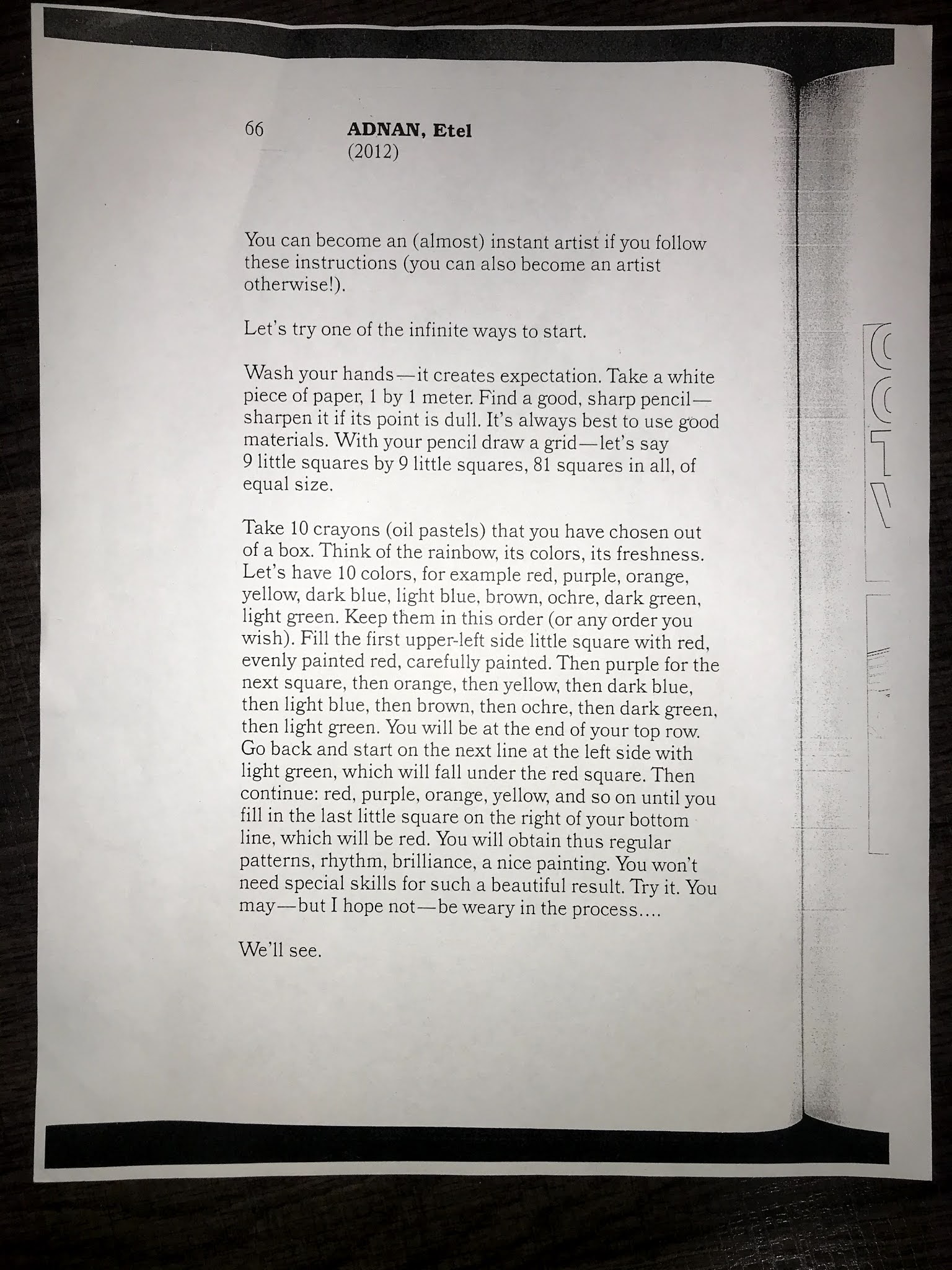
Adnan, Etel
Instructions:
Take a white piece of paper, 1 by 1 meter. Find a good, sharp pencil, sharpen it if its point is dull.
With your pencil draw a grid of 9 little squares by 9 little squares, 81 squares in all of the equal size.
Take 10 crayons (oil pastels).
Think of the rainbow, its colors, its freshness.
Let’s have 10 colors, for example red, purple, orange, yellow, dark blue, light blue, brown, ochre, dark green, light green. Keep them in this order (or any order you wish).
Fill the first upper left side little square with ted, evenly painted red, carefully painted.
Then purple for the next square, then orange, then yellow, then dark blue, then light blue, then brown, then ochre, then dark green, then light green. You will be at the end of your top row.
Go back and start on the new line at the left side with light green, which will fall under the red square.
Then continue: red, purple, orange, yellow, and so until you fill in the last little square on the right of your bottom line, which will be red.
You will obtain thus regular patterns, rhythm, brilliance, a nice painting. You won’t need special skills for such a beautiful result. Try it. You may, but I hope not, be weary in the process…
Process:
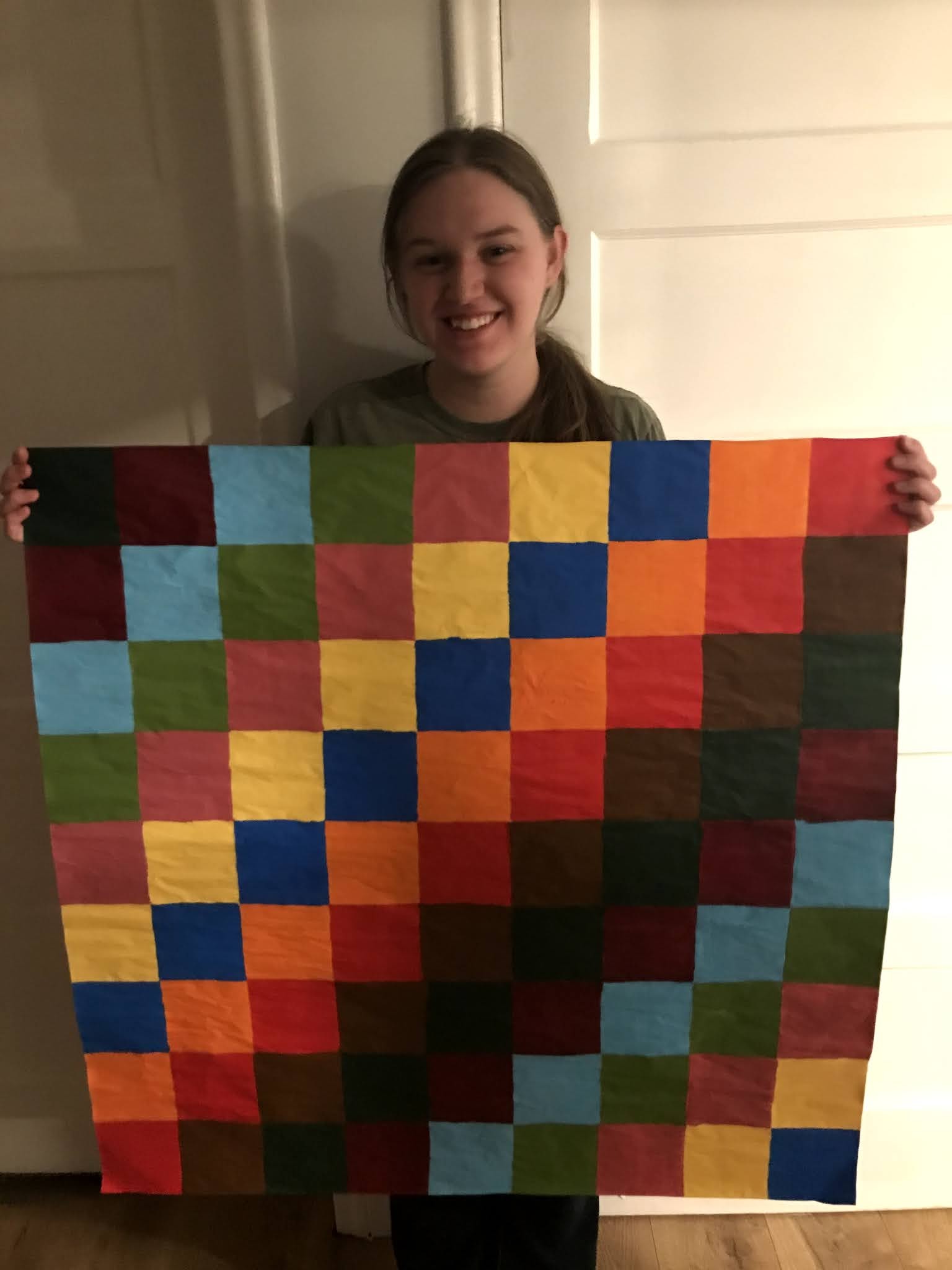
For my process, I change the measure of the square and it is a little small. Also, I change the material because I don’t have any crayons or oil pastels. So I decided to use markers. The results were amazing, I liked how the colors work together. Like the artists said it gives that brilliance, rhythm, and nice painting finish.
Results:

Tuesday, March 9, 2021


Saturday, March 6, 2021

Wednesday, March 3, 2021
Idea for Conceptual Art - "Do it," TDMorris 03/03/21
- Paint a wall in the front room with an alternative perspective, such as a window or door next to a practical window or door in full scale.
- Ensure the painted opening shows the doorway, or window is open.
- Take a series of single photos of a person entering that space through the solid wall.
- The above images have to show time-lapse photography covering the march of time as indicated by the shadows on the wall to include hours instead of minutes for the action to take place.
- Include in this series of imagery sounds or music, or indistinguishable dialogue and edit the passage into a video.
- The person seemingly passing through this wall should be in historical costume, uniform or other dress that is not common in our modern world.
- In the video the character should look back and show emotion of elation, but turns again to show foreboding of the unknown.
- Show the same person looking back into the room through the real window and have him, or her smile and show outwardly show joy.
- Note: if the this room is unable to be produced a green screen project can be envisioned that will show the same action.
- If green screen is used the image inside the window should show an unusual natural environment, such as the ocean, moon scape, or the height of clouds, cliffs or from a old wooden bridge over a height that would make it frightening.
- Mime the words, "Darn, I left my toothbrush in my other suit."
- Fade out in a montage of imagery and unusual patterns.
- Start another sequence repeating the same thing above.
Monday, March 1, 2021
Text piece - Melissa May Beutler
Choose a book
Rip out pg 71
Line 1: block out all words except for #4 and 5
Line 2: block out all words except for #3 and 4
Skip two lines
Line 5: block out all words except for #5 and 6
Line 6: block out all words except for #6 and 7
Repeat for next paragraph, then cut page in half
Choose new booking
Rip out pg 71
Line 1: block out all words except for #3 and 4
Line 2: block out all words except for #2 and 3
Skip two lines
Line 5: block out all words except for #4 and 5
Line 6: block out all words except for #5 and 6
Glue first half of book 1 pg before book 2 paragraph, glue second half after book 2 paragraph

Text Piece - Emilee Thomas
Take a pad of paper with you to a local store.
Go to five various aisles and write down a word or phrase from tags or packaging of items that you see.
Compose a short story using these words/phrases.
Leave a copy of your short story within or under one of the items you selected words from.
Short Story:
Words: Pot, club, broccoli, walnut, little tikes
“That walnut!” Yelled Brenna as a man, holding broccoli in one hand and pot in the other, stumbled out of a club and bumped into innocent little tikes.
Text Piece- Jess Hebertson
1.Pick up a book you’ve read a few times, maybe something you bought second hand. Make sure it’s a book that’s lived a good life but now sits on your shelf collecting dust.
2.Tear out some pages.
3.Read between the lines, mark out a poem. Make something new, create a new meaning inside the words that are already there.


Text Piece - Allison Ipson
INSTRUCTIONS:
1) Choose a book off the shelf.
2) Count the chapters and pick a number between 1 and the number of chapters there are.
3) Continue to pick a number until all the numbers have been chosen.
4) In the order chosen, turn to the appropriate chapter. Write down the first sentence you see within that chapter.
5) Create a short story by combining the sentences. They must remain in the same order, but you can add a filler sentence between each one if needed.
SENTENCES:
1) Mary Alice dodged cobwebs and tried not to brush against anything.
2) You could say one thing for grandma’s method.
3) My tap shoes!
4) “Now I’ve got to change my shoes and walk all the way to the lumberyard in this heat,” she said, as if she hadn’t brought it all on herself.
5) She was tough as an old boot, or so we thought.
6) When grandma’s back was turned, Mary Alice broke open a biscuit and stuck a sausage patty inside it.
7) She stood at her door, large as life – larger, framed against the light from her front room.
8) “Be real careful about calling a customer a liar,” she remarked.
9) The day of judgement came.
STORY:
Mary Alice dodged cobwebs and tried not to brush against anything. You could say one thing for Grandma’s method: Nobody would ever look up here, with all the dirt and grime they’d have to climb through to get to anything. Mary Alice gasped, “My tap shoes!” I looked down at the now brown shoes and tried not to laugh. “Now I’ve got to change my shoes and walk all the way to the lumberyard in this heat,” she said, as if she hadn’t brought it all on herself. After all, this had been her idea. Grandma was tough as an old boot, or so we thought: the reason this room had remained a secret as long as it had.
Earlier that day, when Grandma’s back was turned, Mary Alice had broken open a biscuit and stuck a sausage patty inside it. Grandma stood at her door, large as life – larger, framed against the light from her front room. “C’mon!” whispered Mary Alice, “Right now might be our only chance to find out what Grandma is hiding in the attic!” Looking back at Grandma’s hulking form facing off the traveling salesman on the porch, I could hear her words float in on the breeze: “Be real careful about calling a customer a liar,” she had remarked. I shivered. Whatever we found up here, the day of judgement was about to come.
Subscribe to:
Posts (Atom)